
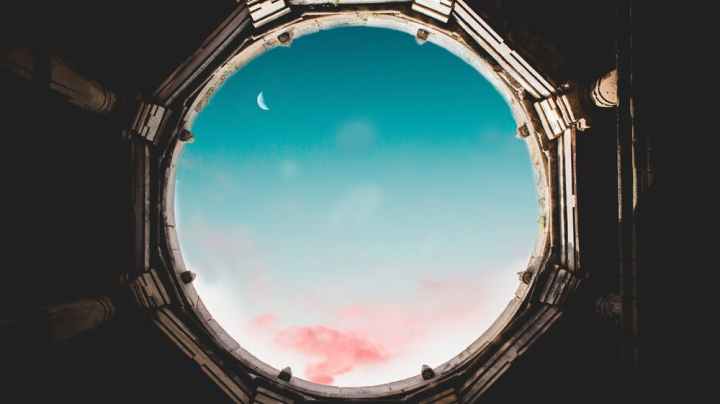
With the recent launch of Artemis II, the first moon mission in 54 years, it’s got me thinking about more things in heaven and earth than are dreamt of in your philosophy. Okay, full disclosure: that’s Shakespeare, not me. But still, do you get the vibe?
When we look into space at night and gaze at the stars, the moon, and the vast blackness between them all, it really does make you wonder about things, don’t you think? Some of those questions are pretty obvious (why are we here? Where will we end? Is all that space really infinite?); others are simply too deep and cavernous for the limits of the human mind.
One thing that has always fascinated me when I look at the full moon on a clear night is that it exists, for me, only through my own eyes: my vision, my fleeting presence. And my time is limited. But as for the moon itself … long after I’ve gone it’ll still wax and wane, still fascinate others, still entice us with moon landings, and the possibility of travelling further.
It’ll continue to rise and set, night after night, through centuries and millennia, regardless of who we are, leaving us all behind. Okay, so one day in the very extreme future I guess it will also have to finally expire – but that kind of time scale is totally beyond our comprehension. For now, while we earthlings are still around, suffice it to say our dear, wise old moon will outlive us all.
The medieval Persian poet Omar Khayyam had similar thoughts when he wrote this beautiful quatrain:
Ah, Moon of my Delight who know’st no wane,
The Moon of Heav’n is rising once again:
How oft hereafter rising shall she look
Through this same Garden after me … in vain!
When I was a child, one Christmas to the next seemed to last an eternity, as did one birthday to the next, one summer to the next, and so on. But with the relentless cycle of days and nights, the years began to speed up, as though impatient with this small mortal life of mine dragging on too slowly.
And as I started to grow older, each year sped up that little bit more, until it became hard to catch up with the passage of time. Even harder to keep it in perspective. Childhood? – yes, that seems like a very long time ago. Perhaps youth as well, depending on how old you are right now. But last year? Five years ago? Ten years ago? Wasn’t that just yesterday?
What on earth happened to the steady tick-tocking of that damn clock of the universe?
A physics teacher once told me that there’s a very scientific explanation for the phenomenon of time seeming to pass faster as we get older, but I can’t now remember what his reasoning was. Other than our brain cells gradually withering with age, what else could explain it?
Or is that it? Is it simply that our brains and minds wither together with time? That as we shrink, bit by bit, so does time? Rather like the concept in that wonderful children’s novel, A Wrinkle in Time by Madeleine L’Engle. Do you know it? Her idea was that time is like a long piece of string which is held at two ends – and sometimes, instead of painstakingly traversing one end to the other, you can simply bring both ends together, saving all that needless trekking in between. A lovely idea.
Isn’t it strange to think that those four brave astronauts in Artemis II are steadily heading towards the very same moon that humans in the Stone Age beheld all those millennia ago on clear, beautiful nights. Same old moon. Hardly changed at all.
We, the tiny mortals down here, are the ones who have slipped – almost imperceptibly – between the ends of that piece of string.
What would happen if we tied a knot in it, I wonder?
 Wendy Skorupski