
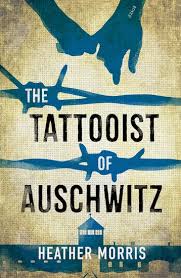
I haven’t seen the recently released series of The Tattooist of Auschwitz, but I did read the book when it was first published. So let me be clear from the outset: this blog post is about the book, not the series.
The trouble is, how can anyone dare to criticise a novel which is based on a true story about two people who fall in love in the death camp of Auschwitz? Well, I’ll dare to criticise.
I’m half-Polish; I live in Krakow, which is only an hour’s drive from Oświęcim (the Polish name of the camp and nearby village) and I’ve visited the place many, many times over the past few decades.
The first time I went, I was only sixteen. The camp wasn’t yet infested with tourists from all over the world, and it felt so real to me, I could barely sleep for many nights afterwards, as I tried desperately to exorcise all those haunting images left in my mind: the crematoria and punishment cells and execution courtyard and experimental medical buildings and all those black and white photographs, all those thousands – a million in total – of lives that endured suffering to an extent we cannot even begin to fathom now, seventy years on.
And that, precisely, is my problem with The Tattooist of Auschwitz. There’s no depiction of the true horrors of the camp, no depth of feeling, no cutting-edge moments or heart-wrenching dialogues that make you want to either clutch the book tighter, or hold back tears while reading. And as for the characters, although we know they existed, they do not come across as real, flesh-and-blood, three-dimensional people. Last but not least, the style of writing is simplistic. At times the story feels like a YA romance that takes place on a school camp with perhaps just slightly stricter teachers than usual.
I’d like to share a relevant memory to this theme. When I was a child in the 1970s, I visited Poland for the first time. One day my aunt, who lives in Warsaw, had a couple of workmen over to her apartment to fix something or other. The workers were probably in their late forties, perhaps early fifties – muscular, tanned, a bit rough and ready, with shirt sleeves rolled up to their elbows.
That’s when I noticed the tattoos.
‘What are those numbers on your arms?’ I asked in my halting Polish.
And so they explained to me what those numbers were. How old they’d been at the time. How it had hurt. How scared they’d been. How they’d been members of the Boy Scouts (a serious movement in Poland), but how nothing had prepared them for Auschwitz. And then, quite spontaneously, they started testing each other on who could recite their tattooed number the fastest without looking at it. They even chuckled when they settled for a draw at the end.
I gaped at the faded tattoos, then the men, utterly fascinated. How could they have lived through all that, and now be laughing?
When they plunged back to work, I dared to ask one more question.
‘Wasn’t it horrible there?’ I said in a meek voice, hoping not to be offensive.
Once again, both men stopped in their tracks.
‘Yeah,’ the taller of the two said. ‘So horrible, you had to make a choice when you got out at the end.’
The second man nodded. ‘A choice to live or die. ‘Once you were a free man again, you either dealt with it and got on with life, or you killed yourself.’
‘Like Stefan,’ the taller guy said.
‘Yeah, hanged himself,’ the other one added, and they both made the sign of the cross.
‘So you chose to live then,’ I said tentatively.
‘Well, we’re here, aren’t we?’ the taller one said, and they laughed again.
‘You’ve gotta laugh, kiddo,’ the shorter one said. ‘Otherwise, what’s the point?’
I’ve never forgotten those two Auschwitz survivors.
A few years later, when I was on another holiday in Poland, I went to Auschwitz for the first time. I remembered those two workers, and imagined them toiling away in the camp in their striped prison clothes – their bodies skinny, flea-bitten, their heads shaven – and I wondered how in the world they had managed to survive. Had they worked in the crematoria, shoving corpses into the furnace? Or perhaps in the sorting area, going through personal belongings of the deceased? Or – worse still – had they showered out the stinking gas chambers after the bodies had been removed, with only urine and human faeces as a reminder that real, flesh-and-blood men, women and children had been wailing in there just minutes earlier, before the toxic fumes overcame them?
And that, precisely, is what the The Tattooist of Auschwitz lacks. Flesh and blood. Reality. Terror.
All the hype surrounding the book shouts out that it’s based on a true story. But quite frankly, I didn’t connect with a single a word of it. At best, it honoured the lives of two people who really had lived and fallen in love, while being prisoners at the most notorious death camp of World War 2. At worst, the whole thing felt like a Mills & Boons romance.
Those two Auschwitz survivors would have made a grittier attempt at it. They could have incorporated all the missing bits – even laughter – that Heather Morris’s version omitted. And yet her book shot to fame, and is now a major box office hit. Don’t get me wrong – I admire her for all the meticulous research she carried out, and I genuinely believe that she meant well. She has definitely succeeded in bringing real Auschwitz survivors to the public awareness, just as Thomas Keneally did with Schindler’s Ark (later made into the film Schindler’s List by Spielberg).
It’s just that … well, I wish someone of Keneally’s calibre had written this story, in order to give it greater depth.
 Wendy Skorupski
Sorry, but I have to disagree with you on this one Wendy.
I didn’t read the book, but I saw the TV series. There were plenty of horrors.. there was depth of feeling and moving dialogues.
There are many movies and series about the Holocaust .. and every story deserves to be told.. and I thought that this one was truly captivating.
LikeLike
Okay, but that’s the series you’re mentioning, not the book. It was the novel I was criticising, and I hold to that. However, perhaps I should have made that clearer from the outset, so thanks for pointing this out.
LikeLiked by 1 person
I totally agree with you. I haven’t seen the series, but I read the book a while ago. I had heard a lot about it and I knew what it was about. Yet I felt nothing when I read it.
LikeLiked by 1 person
And yet these books get published and become “bestsellers”. 🤔 Of course the content is important, and its great that unsung heroes are made known to the public all these decades later, but I just feel it’s a shame that the literary quality doesn’t match the subject matter.
LikeLiked by 1 person