
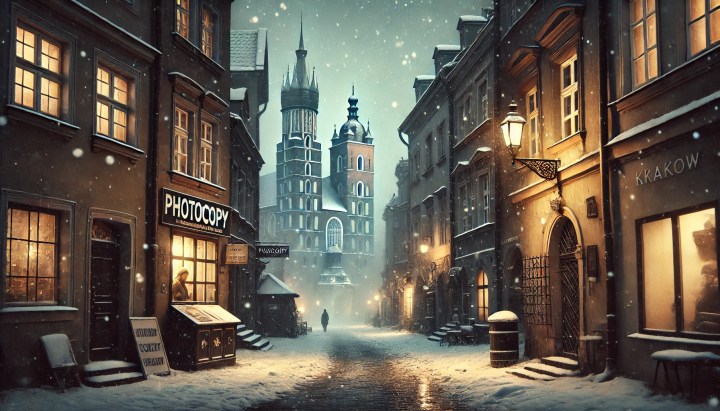
If you’ve ever visited the beautiful historic city of Krakow in Southern Poland, you might be interested in reading on. The extract below will take you on a little time warp back to 1992, the year I moved here. That was barely three years after the end of Communism. The unforgettable atmosphere back then, and the ethereally white Christmas I experienced, is what inspired me to write a love story based in this magical place. It’s about a lonely bachelor with a club foot and a chip on his shoulder, who falls in love with a mysterious woman who keeps coming back to his small photocopying shop.
This passage takes place on Christmas Eve 1992, when temperatures reached minus seventeen centigrade and snow covered the entire city. I know; I was there at the time! The novel is written from the point of view of the grumpy protagonist, Leo. All place names and streets really exist.
…………………………………………………………….
The Diary Keeper
An icy blast of snow splatted into my face as soon as the eighteenth-century door gave way to the street outside. Ducking my head against further onslaughts, I locked up and stepped onto the white-coated pavement.
The Number 13 tram stop is a good ten minutes’ walk from my photocopying shop in the old town. I made my way with lowered head, dragging my left foot down the deserted street, crossing the road and slipping into the shadowy avenues of the exquisite ring of parkland that surrounds the historic heart of Krakow. The Planty, as it’s called – one of the few place names that the fresh droves of tourists manage to get their tongue round without sounding like linguistic imbeciles. Here, the trees were bowed with their heavy winter burden: whitened canopies that scintillated in the watery street lights.
But it was too cold to ponder over their beauty. So, I carried straight on until reaching the main market square of Krakow. Tonight, the three-minute walk across its glossy medieval expanse was nothing short of perilous, unless you happen to be a world champion ice-skater, which I most certainly am not. Chance would be a fine thing. What chances are ever given to a man who’s had the misfortune of being born with a club foot? Anyway, that’s beside the point. Mustn’t get morose.
Next task at hand was to leave the market square at its furthest end and plough through the un-shovelled layers of snow on Florianska Street, leading to the ancient city walls that were crowned by a central archway. Hobbling beneath this, I turned right into Pijarska Street. The old Barbican on my left was looking particularly ghostly tonight, trembling in a gossamer veil of snow-mist as though transported from some medieval ice kingdom.
After crossing another stretch of the Planty, I at last reached my destination: the Nr 13 tram stop. Not a soul was in sight. Only at this point did my spirits begin to rise. It was, after all, Christmas Eve. A special time. The thing I love most about it is the silence. Beyond the home boundaries of seasonal cooking smells and lively chatter, silence seeps through the deserted city like a snow drift. Even the beggars are nowhere to be seen, all of them having scuttled away to their various shelters and riverside tunnels.
I had to wait longer than usual for my tram. The temperature was dropping by the minute and the snow was stinging my face. I pulled my scarf up above my nose and mouth. It only partially eased the pain; it didn’t help my toes and fingertips. Earlier on the weather forecast had announced that it was minus fifteen; now I guessed it to have dropped to at least minus seventeen. Probably it would reach the minus twenty mark overnight. People died in this weather. Every year you heard about it on the news. Christmas in bright living rooms and death in dark alleys. Before 1989 it was just the drunks whose rigid corpses were periodically discovered beneath a patina of drifted snow in the mean light of morning. Now it’s also the homeless, the drug addicts and the AIDS-sufferers. All the latest exports from our glorious Western neighbours.
At last, the Nr 13 tram arrived. I waited for the metal doors to judder open before clambering inside. Warmth! There were only two other passengers in the entire carriage. Normally people were crammed together inside the bellies of these roadway serpents: tangled masses of smelly, sweaty, undignified human flesh that were gobbled up and spewed out at regular intervals. But not tonight.
Twenty-five minutes later, I reached my stop in the high-rise suburb of Nowa Huta. Let me add here, for the record, that Nowa Huta is a place as different from the domed and gargoyled centre of Krakow as caviar is from stewed cabbage. Nowa Huta, the Stalinist dream that had woken up to the alluring world of democracy. Nowa Huta, more famously known for its monolithic steelworks. Nowa Huta. It has quite a ring to it, if you say it often enough. I should know. I’ve lived there all my bloody life.
My particular dream consisted of a twelve-storey block in the Piastow estate: a sprawling concrete settlement that had been carved into the once-rural landscape back in the nineteen-fifties. All the tower blocks are still inhabited by tens of thousands, but have now lost their grit. There they stand, a forest of concrete and steel, unchanged for the past forty years yet not quite sure how to handle their new freedom. I myself am one of those tens of thousands. I am also surrounded by concrete and steel. The only thing that can be said in favour of my miniscule seventh-floor flat is that it offers exquisite views in the evenings, when the panoramic lights of Krakow stretch out for miles, as though winking at all the stupid apparatchiks who got it wrong for so many years.
I pushed open the metal door to Block Nr 25A and stepped inside the grubby public entrance. While waiting for the lift to descend I examined the graffiti on the walls. Swear words and swastikas vied against hearts and arrows. Graffiti is one of the more colourful additions to our new freedom of thought and expression. Before 1989 I had only ever seen such bizarre urban decorations in films made in the West. Now it’s part of the new artwork of our city.
The lift arrived. Its doors pinged open and I stepped inside. More graffiti. And the smell of urine. Cat, dog or human – it was hard to tell which. But at least that wasn’t new. At least body fluids couldn’t be blamed on democracy.
Again, the doors pinged. I stepped out into the smelly stairwell of the seventh floor. Flat number 62 faced me. That was mine. The flat where I had been born, baptised, gone to school, where my mother had raised me and my two brothers, where we’d prepared for first communion and done our homework and passed our matriculation exams by the skin of our teeth, and eventually, one by one, abandoned the home hearth. Except me.
I unlocked the front door. All four locks, to be precise. The crime rate has soared these last three years – another insidious Western export. And Nowa Huta, God bless its working class soul, has become particularly partial to this latest trend from the land of the free.
Once inside the crammed hallway of my flat, I turned on the light and started the laborious process of shedding my winter gear, garment by garment. Then I headed for the living room, all of three metres down the squashy corridor. It had been six hours since I last saw Lidka, and I’d missed her.
‘So, how’s your day been?’ I called out as I humped my way across to the sofa and sat down beside her. ‘No news for me, then?’
I stretched out my hand to the wobbly standard lamp by the coffee table, but paused before switching it on. At this magical time of year I like to savour a few moments of the snowy half-light that seeps in through the uncovered windows. There should also have been the soft amber glow of fairy lights from the Christmas tree. Somehow, this year I couldn’t be bothered with any of that. Without Mama around anymore, it hardly seemed worth it.
I flicked the switch on the lamp and at last Lidka grunted in vague acknowledgement of me. That’s ferrets for you, but I love her all the same. My only regret is that I didn’t think of getting one years ago. Yes, a dear little furry friend would have helped me ignore my younger brother’s malicious banter before he abandoned the family bosom years ago to go off in search of army adventures. (He might now lie in some cemetery in the Caucasus, for all I know and care.) It would have distracted me from the snide remarks of my older brother before he emigrated to America, taking with him his odious wife and three brawling children. And it would certainly have calmed down my nerves around Mama before her degenerating language and oozing bodily functions became so alarming that I had no choice but to deliver her to an old folks’ home in the nick of time. It was only after her death, when some weirdo-client brought in a manual for photocopying that was entitled ‘How to look after your Pet Ferret’ that the idea first occurred to me. The title should have been followed by ‘And Eradicate its Smell’, but that’s beside the point. Yes, it was only then that I thought how nice it would be to have a companion in my flat who could neither nag nor answer back.
So now, eleven months down the road, it’s just me and Lidka. And that’s the way I like it.
 Wendy Skorupski
Brings back the atmosphere of early 90s in Kraków, also the winters as they uesd to be in the past: severe, frosty and very white, heavy with snow. The character takes after Maugham`s character Philip from “Of Human Bondage”. What does he take after him? Only the club foot:)
LikeLike
Yes, you’re right. Thanks for the perceptive comment about Maugham.
I miss those early 90’s in Krakow …
LikeLike
I love how you paint pictures with words ☺
LikeLiked by 1 person