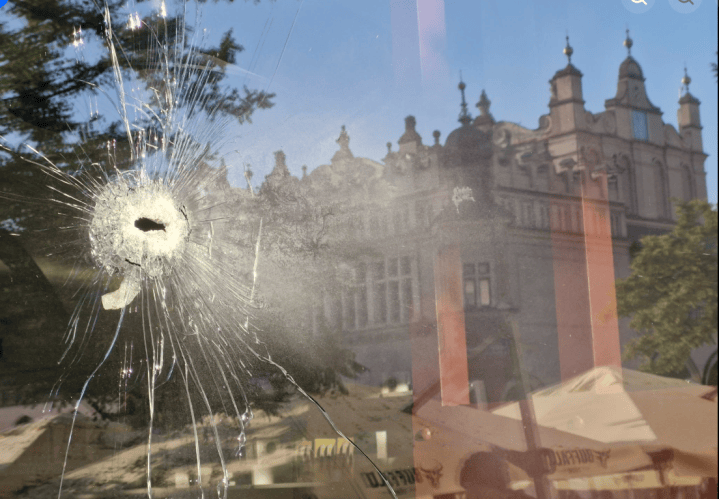
It was an ordinary November afternoon in the heart of Kraków – the beautiful historic city that has been my adoptive home these past thirty-four years.
Tourists were strolling past, phones at the ready to click that perfect view, that selfie. Shop workers attending to customers. Waiters serving drinks and meals, presenting bills, pocketing tips. Some of them were on a break – leaning against an outside wall or in an open doorway, indulging in a quick cigarette. Perhaps nattering to a colleague during a quiet spell. Perhaps simply watching life go by. Horses and carriages all around, some of them waiting, some of them clip-clopping past.
And then. The first shot fired. One life ended.
And another – a second life ended.
And another. And another. And another. And another.
Six altogether. Six people, each absorbed in their own lives, their own thoughts, their own reasons for being precisely there, at that moment. Six people who had no idea what that precise moment would entail. Six people, snatched away at random.
But were those six deaths on that November afternoon random?
When I was seventeen, I remember being fascinated by Thornton Wilder’s book, The Bridge of San Luis Rey. I was both horrified and captivated by those five people who had lost their lives one beautiful, blue-skied day in Peru, way back in 1714. Why them, of all people, I used to ask myself? All they’d been doing was walking across a flimsy bridge – a mere ladder of thin slats swung out over the gorge, with handrails of dried vine, according to Wilder. But it was a bridge that was doomed, at that very moment, to fray, snap, and finally, to collapse, plunging each one of those hapless human beings to their deaths. Okay, it was only a novel; but the cruel randomness of their deaths stuck with me.
And now, several decades later, it’s back with me. Although the cause is different, the randomness is the same. Wilder’s characters were killed by an old weathered bridge snapping in two; Kraków’s victims were murdered by a man with an AR-15-style semi-automatic rifle. Someone who had made a deliberate decision to aim, fire, and destroy. To snatch away however many random lives he could.
Six, as it happened – on the Main Market Square in this beautiful historic city.
Why did those particular six passersby on that November afternoon, ranging in age from thirty-two to sixty-one, have to die? Why them, for crying out loud?
Did some Greater Power, looking down from up there on high, pick each one of them out individually, with some abstruse logic that’s way too complicated for us ordinary mortals to comprehend? Did it point a scrawny, Blakean finger at the Kraków Market Square on that deceptively peaceful afternoon in November, and decide to snatch away six lives?
Out of all the thousands of people milling around, why those six? It’s a question the bereaved families and loved ones must be asking again and again and again. Why my son, my wife, my mother, my sister, my friend? I can almost hear the agonising WHY echoing in their grieving minds.
I don’t know the answer, and I don’t expect any of us will ever know.
Whenever the shock of a mass shooting hits the media, the perpetrator becomes a name. A face. Even a biography. He dominates the headlines, guarantees his place in history. But the people he killed? Although their stories may be told in the immediate aftermath, all too often they eventually become mere numbers. Statistics.
I want, in my own small way, to redress that balance. I want to give the six random victims of Kraków’s November 7th shootings the space they deserve in my personal tribute to each of them.
So here they are, those six whose separate lives converged in a catastrophic handful of moments that none of them could have anticipated.
James Thomas Campbell, 32
James was the youngest victim, and almost certainly the first to be shot. He was from Prestwick in South Ayrshire, Scotland. He liked to be called Jamie, and shared the same first name as my son, who is also in his thirties. I cannot help thinking how easily it might have been my Jamie. He was involved in the Scottish music scene and was a popular DJ. He also rented out a flat to tourists in Scotland. How cruelly ironic that he should lose his life while being a tourist himself. I can’t bear to think of all that talent and energy and passion snatched away in a handful of seconds. All his life in front of him.
Izabela Woźna, 53
Izabela was a talented artist from Rataje near Chodzież in Wielkopolska. She’d held exhibitions of her paintings at art fairs in Gdańsk, Szczecin and Warsaw and was gaining recognition. She’d travelled to Kraków to hold another exhibition of her impressive paintings, which took place the day before the fatal shootings. At least, if there is any comfort to be had, she had the joy of that experience on her last day alive. Earlier that Saturday afternoon, she’d been enjoying the sighs of the Kraków Rynek with friends. She leaves behind a husband and four children, two of whom are eleven-year-old twins. Iza, I pray that your artwork will shine on in Kraków and all of Poland, and perhaps now in other countries as well, as a beacon to your beautiful existence.
Ewelina Serafin, 47
Ewelina was a charity worker and volunteer from Sędziszów Małopolski. She loved travelling and had lived in the United States previously. She worked for charities, and is remembered by her colleagues as a kind, exceptionally caring person who had a big heart, who loved animals, and who always put the needs of others first. She willingly devoted her free time to helping people, touching the lives of many in need. The volunteers in the Szlachetna Paczka charity mourn her deeply, and have promised that she will always remain part of their community. In the photographs I’ve seen of Ewelina, it’s her warm beautiful smile that stays with me. Somehow, it seems to reflect the kindness that so many people remember in her.
Dorota Baran, 61
Dorota was originally from Zielonka, near Kraków, and lived in the Bieżanów district with her elderly mother. Her younger sister, Joanna, wrote a beautiful tribute in loving memory of Dorota: To the world, she may have been just one of many. To us, she was irreplaceable. Dorota cared unfailingly for her 80-year-old mother, ensuring that she took her medication, had her morning coffee, and never felt lonely. Such small, everyday acts of kindness, yet so precious. Her mother may still have others to care for her, but who will replace Dorota’s loving, daily presence? As her sister said: Let us not allow her senseless death to be forgotten.
Robert Kosidło, 51
Robert had worked on Kraków’s Main Market Square for more than twenty years. He helped traders set up stalls, carry their merchandise and pack everything away again. He brought them teas, coffees and meals, especially on cold days. He himself also sold flowers. What is particularly heartbreaking is that he’d sustained a limp after a serious accident in Italy some years earlier, and, as a result, was unable to run away fast enough from the killer’s shots. He died just as he reached the entrance to the shop Zara. He will be remembered for his extreme kindness, honesty, and willingness to help.
Unnamed Austrian woman, 51
Sadly, we don’t know the name of the woman from the Gänserndorf district of Lower Austria. What we do know is that she was visiting Kraków for the weekend with her husband, who was also shot, but survived. He has now been transported back to Austria for further medical care. We also know that she was the mother of two daughters, and that she is remembered fondly by the neighbours in her village. As Gänserndorf is not too far from Vienna, where I spent eight years of my childhood, I feel a tender, albeit tenuous, connection with this victim, in the absence of being able to call her by her name.
……………………………………..
Postscript: Three other innocent lives were tragically taken by the killer: those of his parents and his younger sister, whom he shot before the attack in Kraków.


That’s a really moving tribute Wendy. nice one,
Andy
LikeLiked by 1 person